



Grounds maintenance and street cleansing teams make prioritisation decisions every day. Which locations need attention now? Where is intervention becoming urgent? And which work can safely wait?
Traditionally, many of these decisions depend on experienced field professionals who know the area and can recognise where action is needed. That expertise remains essential, but it is also becoming increasingly scarce.
The challenge is therefore not simply having enough people to carry out the work. It is making the knowledge needed to set the right priorities available across the entire team.
As grounds maintenance expert Jeroen van Ammers explains:
“Image recognition can really help to solve our problem with people who have the knowledge about what to do and what not to do.”
Making Conditions Across the Public Space Visible
The condition of the public space is constantly changing. Weeds grow at different rates, litter appears throughout the day and maintenance needs vary between streets, neighbourhoods and seasons.
Knowing exactly where attention is needed therefore requires an up-to-date picture of what is happening outside.
Image recognition can support this by detecting conditions across the public space during regular driving routes. Instead of relying only on individual area knowledge or additional inspection rounds, organisations gain a more objective and frequent source of information about current conditions.
This does not replace the expertise of field professionals. It gives them additional information to make better decisions.
From Detection to Clear Priorities
Simply detecting weeds, litter or other conditions is not enough. The information needs to help teams decide what to do next.
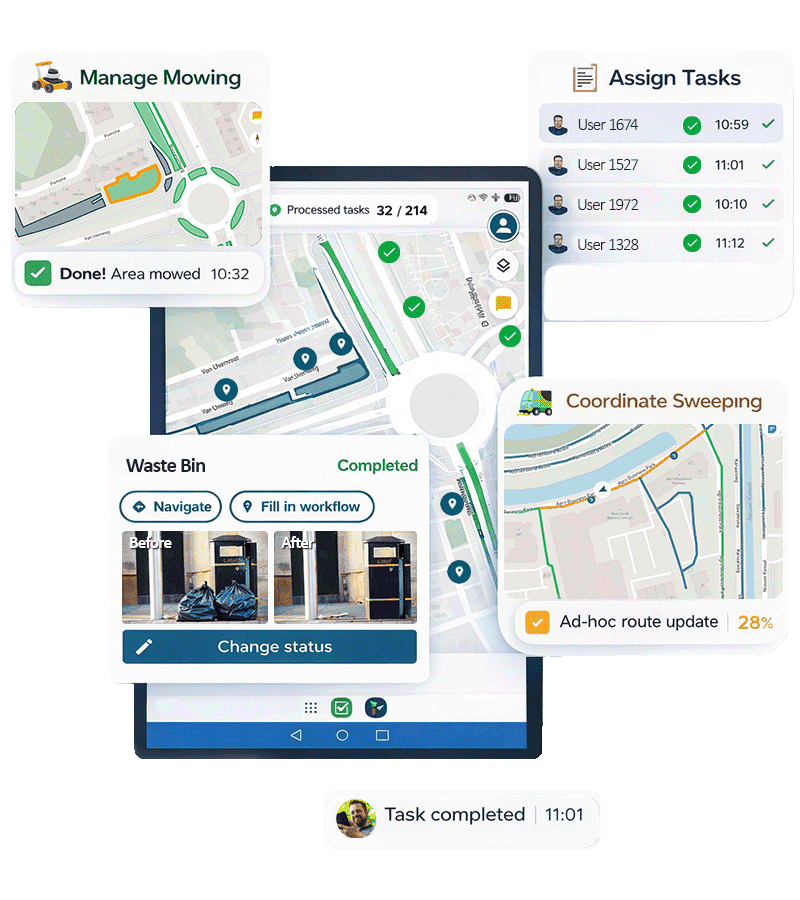
Within Jewel Image Recognition, detections can be combined with other operational information and translated into clear priorities for daily execution. Depending on how an organisation works, these priorities can be shown visually on a map or converted into specific tasks (niet specifieke taken maar uitvoeringsinformatie) for field teams.
This means teams do not need to inspect every location themselves before deciding where to start. They can focus their attention on the locations where intervention is actually needed.
As Jeroen explains:
“We enable the teams outside to make their own priorities about what to do and what not to do.”
Supporting Self-Steering Field Teams
The goal of image recognition is not to tell field professionals exactly how to perform their work.
It is to give them the information they need to make those decisions themselves.
When current conditions and priorities are clearly visible, teams can organise their work more independently and respond to what is actually happening outside. Planners maintain an overview of the operation, while field professionals retain the freedom to use their expertise in the field.
As Jeroen puts it:
“It makes work much easier and we can concentrate on the priorities of today.”
From More Data to Better Daily Decisions
(waarom wij een betere oplossing hebben toevoegen: Je hebt niet altijd zicht op alles ook met beeldherkenning. Wij zorgen door data uit het verleden in combinatie met beeldherkenning zo vul je het complete beeld van de prioriteiten. Dus niet alleen je huidige opnames. Niet zomaar beeldherkenning maar essentieel onderdeel van je operationale uitvoering) Image recognition creates the most value when insight becomes part of daily execution.
By continuously making conditions in the public space visible and translating those insights into practical priorities, organisations can reduce their dependence on scarce individual expertise while giving field professionals better support.
The result is not more data or more control. It is a clearer answer to the question teams face every day: where should we focus our attention today?
Discover how Jewel Image Recognition helps grounds maintenance and street cleansing teams turn current conditions into clear priorities and practical action.


No Comments Yet
Let us know what you think